
Llanymynech Limeworks
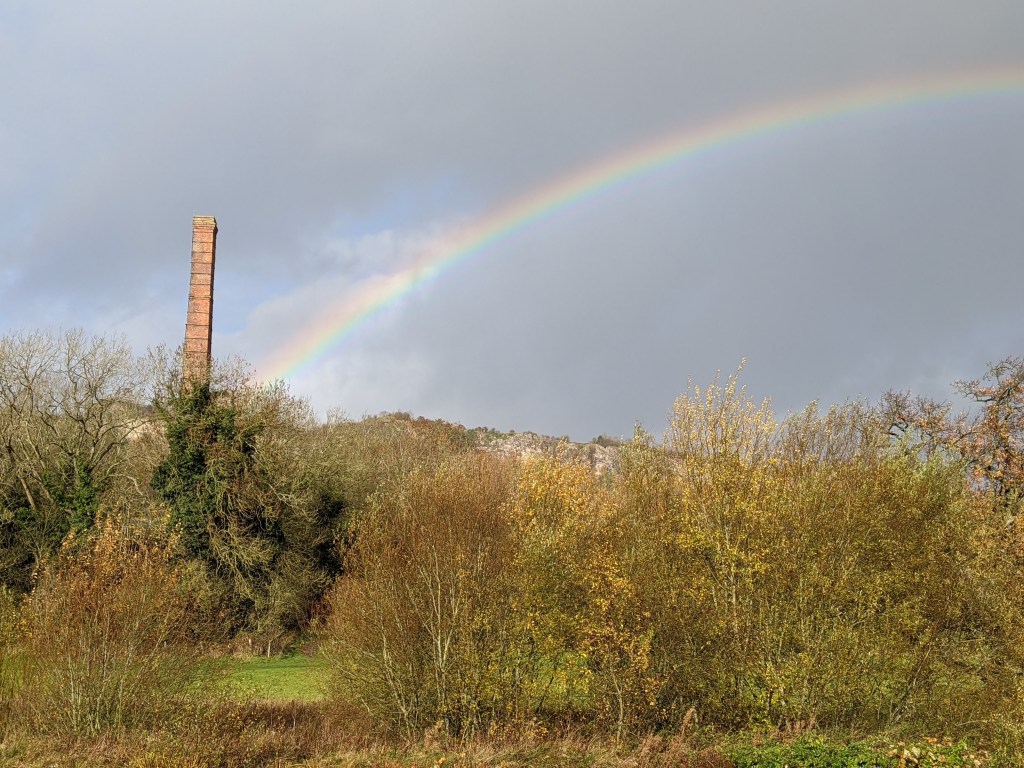
The disused limestone quarry and associated industrial remains at Llanymynech dominate the landscape of today and had a huge impact on the development of this landscape in the Eighteenth, Nineteenth and early Twentieth Centuries. Similar landscape features exist throughout the country where limestone proliferates. But why was it such an important commodity and the demand for it so high that it led to the creation of these industrial remains, construction of canals and a network of railway lines over much of the country?
Limestone is made up from the fossilised remains of shells, corals and other marine life which has been compressed in layers along with other older rock particles. In its pure form limestone is known as Calcium Carbonate. When limestone is heated to an extreme heat of at least 900C in it becomes Calcium Oxide.
One of the earliest uses of limestone was as a building material; for the actual stones themselves, in mortar, plaster and as a whitewash. Mortar was made by mixing sand and ground limestone together with water. When it dried naturally in the air it set solid, binding the stones together. The rising population of the nineteenth century and the development of towns resulted in a tremendous growth in the building industry and a greatly increased demand for mortar and hence lime.
This same rising urban population led to an increased demand for food. This resulted in the need for the land to be more productive, this could be achieved if the land was treated with lime.
Lime was used to reduce the acidity of the soil resulting in better crop production. It was also used on heavy land to improve the soil structure by breaking up heavy clay clods in a process known as ‘flocculation’. This process allowed more oxygen into the soil, making it drier, warmer and encouraged more worm activity which resulted in more nutrients being introduced. The lime also released any iron or aluminium compounds held in the subsoils which in return released more phosphates into the soil which are beneficial to plant growth.
Lime was also spread on pasture fields to enrich the grazing land which was quickly depleted of lime when grazed by cattle. It was also used as a preventative measure against various stock diseases.
The extension to the Ellesmere Canal, now known as the Montgomery Canal, was built specifically to transport the limestone for agricultural use. Work started on the canal 1793 and it had reached Garthmyl by 1792. A new company was formed, and it finally reached Newtown in 1821.
Lime was a key component in the iron production process. When added to the furnace it acted as a flux enabling the impurities to be easily removed, particularly those associated with the ash produced from the coal or coke used in the furnace. The industrial revolution and the growth of the Iron Industry fuelled the demand for lime.
The Enclosure Acts which led to the formation of new enclosed fields resulted in the creation of new and improved roads. Limestone was used in the construction of these new roads as well as for the tow paths alongside the newly built canals.
Limestone was also used in a variety of other ways including purifying sewers and removing impurities in the production of town gas. It was sold for chicken grit and as stone for ornamental grottos along with uses in many other industrial processes such as tanning and the production sugar.
The early Twentieth Century saw the development of new types of mortar and cement alongside the introduction of chemical fertilizers resulting in an associated drop in demand for lime. As a result, in the early twentieth century the Llanymynech Quarry closed.
References:
HER. (2022, Jan 3). Heritage Gateway. Retrieved from Shropshire HER: https://www.heritagegateway.org.uk/Gateway/Results_Single.aspx?uid=MSA3273&resourceID=1015
Johnson, D. (2018). Lime Kilns History and Heritage. Stroud: Amberley Publishing.
Kelleher.S.MA. (2011). Archaological Desk Based Assessment of Land at Llanymynech. Ironbridge Archaology: Ironbridge Gorge Museum Trust.
Williams, R.(1989). Limekilns and Limeburning. Oxford: Shire.
Williams, G. (Revised 1997). Much Wenlock’s Limestone Quarries. Much Wenlock: Ellingham Press.
To follow my blogs and find out more about Lime Working and our ancestors subscribe to my blog below.
 Hidden Histories Genealogy